
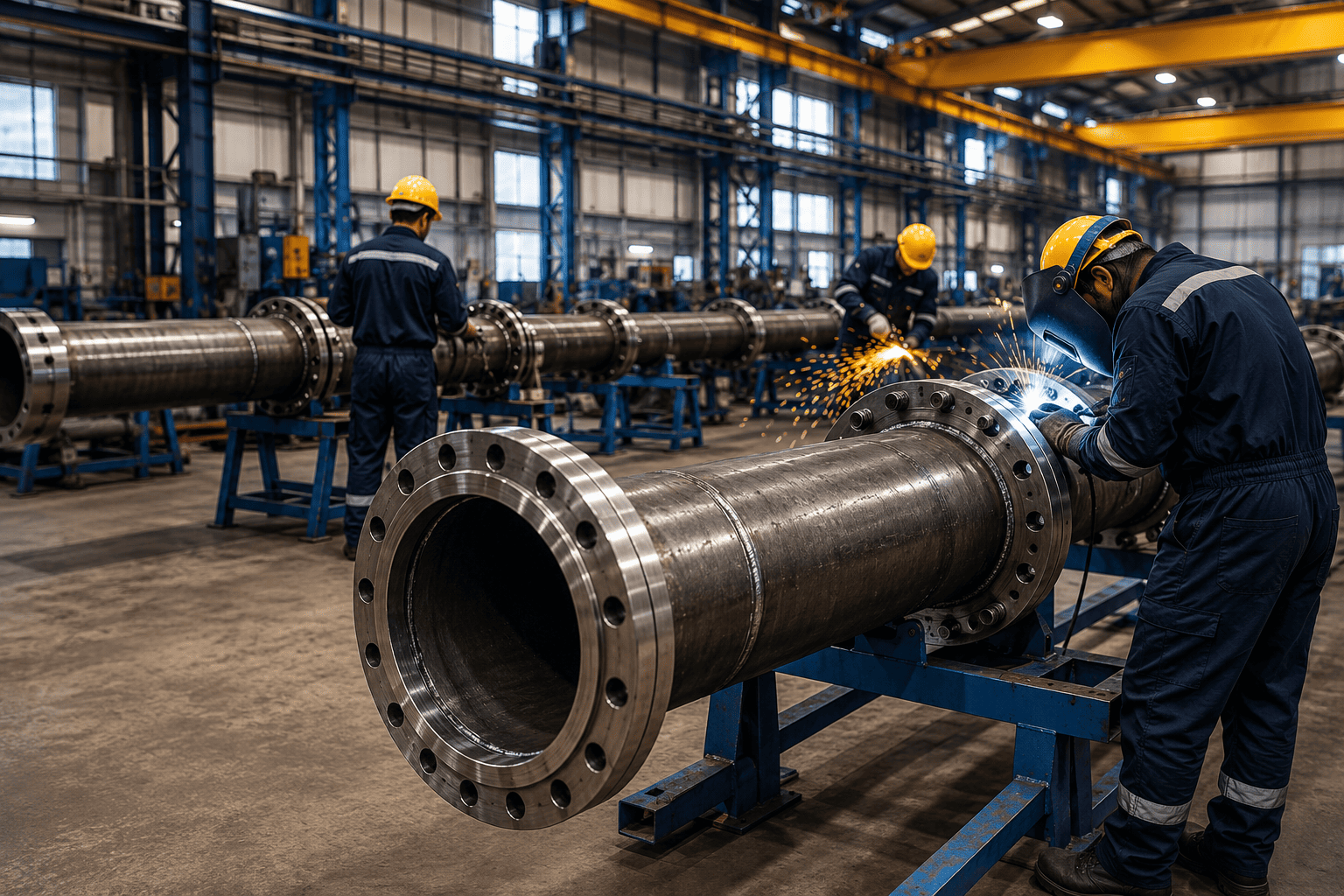
Pipeline spool fabrication in UAE plays a central role in keeping the country’s energy, industrial, and water infrastructure running safely and efficiently. From offshore platforms in Abu Dhabi to onshore processing facilities across the Emirates, pipeline spools connect equipment, redirect flow, and absorb the stress that comes with high-pressure, high-temperature operations. Without properly fabricated spools, even the most advanced piping network is only as strong as its weakest joint.
In this guide, we’ll break down what pipeline spool fabrication actually involves, why it matters so much for UAE industries, what standards and materials are used, and how to choose a fabrication partner you can rely on for years of trouble-free service.
A pipe spool is a pre-assembled section of piping made up of straight pipe, elbows, tees, reducers, flanges, and other fittings that is welded together in a controlled shop environment before being transported and installed on site. Instead of welding pipe joint by joint in the field, engineering teams design spools as modular units based on isometric drawings, then have them fabricated off-site under strict quality control.
This approach is faster, safer, and far more precise than pure field welding, which is exactly why pipeline spool fabrication UAE has become the preferred method for oil and gas, petrochemical, and industrial projects across Abu Dhabi, Dubai, Ruwais, and the wider Emirates.
The UAE is home to one of the world’s most demanding energy sectors. Companies operating in this environment need piping systems that can withstand:
Because of these demands, fabrication providers serving the UAE market must combine advanced welding technology, certified materials, and rigorous inspection protocols. A single weak weld or dimensional error in a spool can lead to costly delays, failed hydro-tests, or worse safety incidents once the pipeline is operational.
A reliable fabrication partner follows a structured, repeatable process to ensure every spool meets project specifications. Here’s what that typically looks like:
Fabrication begins with a detailed review of isometric drawings and P&IDs (Piping and Instrumentation Diagrams). Engineers extract exact dimensions, wall thicknesses, material grades, and fitting requirements to generate an accurate material take-off (MTO) before any cutting begins.
Pipe, fittings, and flanges are sourced from approved, traceable suppliers. Every piece of material carries mill certificates confirming chemical composition and mechanical properties, which is essential for oil and gas projects where full material traceability is mandatory.
Pipes are cut to precise lengths and beveled to prepare clean edges for welding. Modern shops use CNC pipe cutting and beveling machines to achieve consistent bevel angles, reducing weld defects and rework.
Pieces are aligned and tack-welded into position according to the isometric drawing. Correct fit-up is critical misalignment at this stage leads to stress concentration points that can cause premature failure once the spool is in service.
Certified welders use qualified welding procedures (WPS) suited to the pipe materials carbon steel, stainless steel, duplex, or alloy steel and the service conditions. Common processes include SMAW, GTAW (TIG), and SAW, depending on pipe diameter, wall thickness, and project specification.
Every weld undergoes visual inspection, and depending on the criticality of the line, additional testing such as radiography (RT), ultrasonic testing (UT), magnetic particle testing (MPT), or dye penetrant testing (DPT) is carried out to confirm weld integrity without damaging the spool.
Fabricated spools are pressure-tested with water (or sometimes pneumatically) to confirm they can safely handle operating pressures with no leaks or deformation.
Once approved, spools are blasted and coated or painted according to project specification a step that’s especially important for spools destined for offshore, marine, or corrosive service environments common across the UAE coastline.
Each spool is marked with its unique identification number matching the isometric drawing, then carefully packed and transported to site for installation, minimizing the risk of damage in transit.
Different projects call for different materials depending on the fluid being transported, pressure rating, and environmental exposure:
An experienced fabricator will guide clients on the right material selection based on the specific service conditions of each pipeline.
Quality spool fabrication is never done “by eye.” It follows internationally recognized codes, including:
Adherence to these codes ensures spools are accepted by third-party inspection agencies and asset owners such as ADNOC and its group companies, which set some of the strictest quality benchmarks in the region.
Each of these sectors has unique pressure, temperature, and corrosion requirements, which is why customized, project-specific fabrication matters more than off-the-shelf solutions.
Dimensional inaccuracy: Even small deviations can prevent a spool from fitting correctly on site. This is prevented through CNC cutting, precise fit-up checks, and dimensional verification before welding is finalized.
Weld defects: Porosity, undercutting, or incomplete penetration can compromise a spool’s integrity. Certified welders, qualified procedures, and thorough NDT catch these issues before the spool ever leaves the shop.
Material mix-ups: Using the wrong grade of steel can be dangerous in high-pressure service. Full material traceability, color-coding, and certificate verification prevent this.
Project delays: Tight UAE project timelines leave little room for rework. Detailed planning, in-house fabrication capacity, and parallel processing of multiple spools help keep schedules on track.
One factor that’s often underestimated is proximity. The UAE’s major energy and industrial hubs Mussafah, Ruwais, Jebel Ali, and the offshore fields off Abu Dhabi’s coast depend on fabrication shops that can turn drawings into finished spools without the delays that come with importing from overseas.
Local fabrication in Abu Dhabi offers several practical benefits over importing spools from outside the region:
For contractors managing tight EPC schedules, working with a fabricator based in Abu Dhabi’s Mussafah industrial area means spools can be inspected, tested, and delivered to site with far less schedule risk than sourcing from fabricators outside the region.
Not every fabrication shop is equipped to handle demanding energy-sector work. When evaluating a potential partner, it’s worth asking:
A fabricator that can answer these questions with confidence, backed by real project references, is far more likely to deliver spools that pass inspection the first time and install without issues on site.
Bright Side Steel, based in Mussafah, Abu Dhabi, specializes in precision steel fabrication for the energy, industrial, water, and marine sectors across the UAE. Our capabilities include custom fabrication and machining, pressure vessels, storage tanks, heat exchangers, and pipeline accessories, giving us the in-house engineering depth to handle complex spool fabrication projects from drawing review through to delivery.
Here’s what sets our approach apart:
Whether you need a handful of spools for a small tie-in or a full package for a major processing facility, our team works closely with your engineering and procurement staff to make sure every spool arrives ready to install right the first time.
Reliable pipeline spool fabrication UAE work is the foundation of safe, efficient piping systems across the country’s oil and gas, industrial, water, and marine sectors. From accurate drawing take-offs to certified welding, rigorous testing, and on-time delivery, every step matters when the end result has to perform under real operating pressure for decades.
If your project needs a fabrication partner with the engineering expertise, equipment, and quality systems to get it right, Bright Side Steel is ready to help. Get in touch with our team to discuss your pipeline spool fabrication requirements, or request a quote for your next project.
A pipe spool is a pre-fabricated, pre-welded assembly of pipe and fittings built to an exact isometric drawing, whereas individual fittings are the separate components (elbows, tees, flanges) used to build that assembly.
Timelines depend on spool complexity, material availability, and quantity, but shop fabrication is generally significantly faster than field welding because multiple spools can be produced in parallel under controlled conditions.
Fabrication shops in the UAE typically handle a wide range of diameters and wall thicknesses, from small-bore process piping up to large-diameter transmission pipe, depending on the shop’s equipment and lifting capacity.
Yes. Most oil and gas projects require third-party inspection agencies to witness NDT, hydrostatic testing, and final dimensional checks before spools are approved for shipment.
Yes. Spools destined for offshore platforms or coastal environments are typically blasted and coated with corrosion-resistant coating systems suited to marine exposure.
Shop fabrication allows for better weld quality control, safer working conditions, faster overall project schedules, and easier testing all of which are harder to achieve consistently with field welding alone.


