
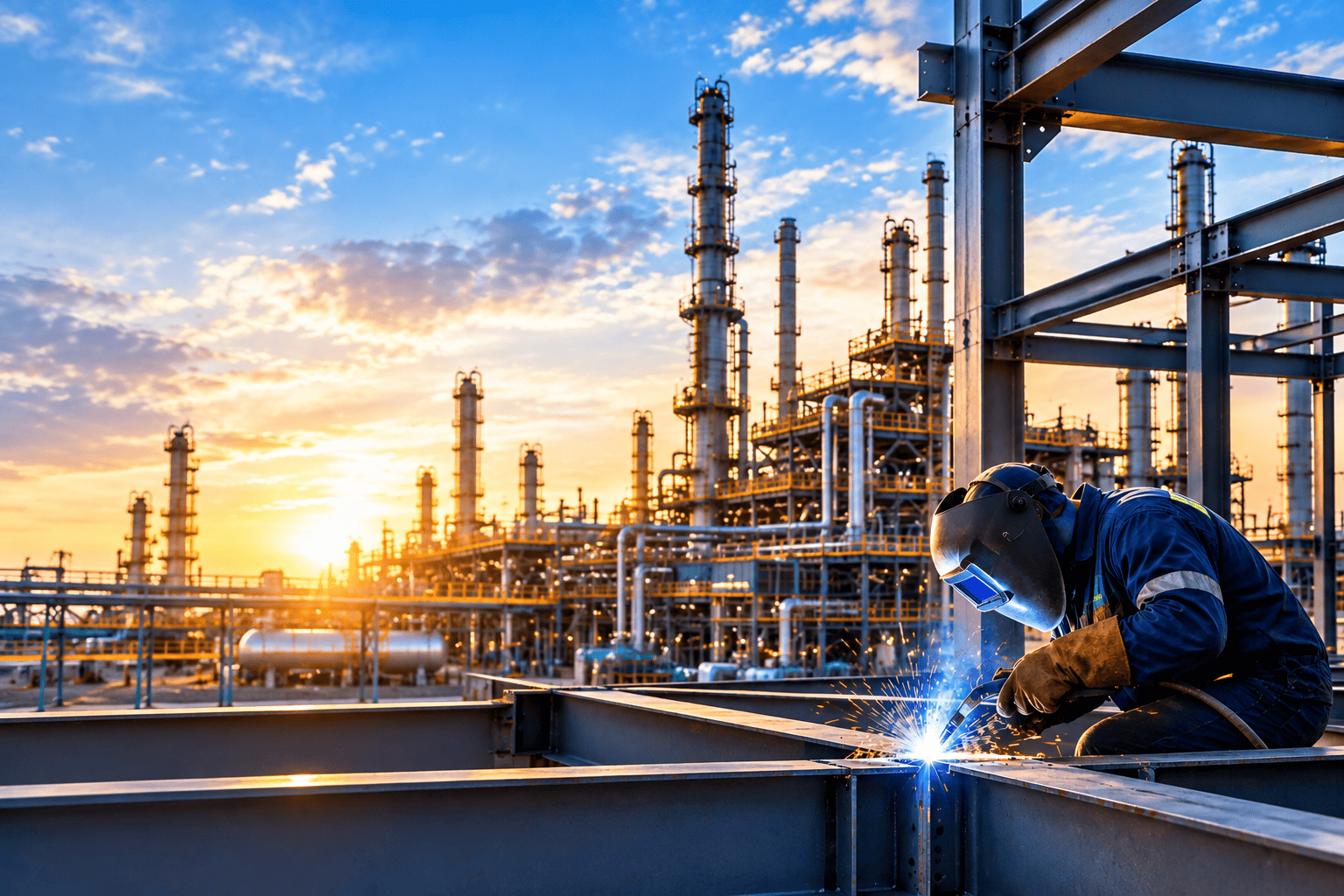
The UAE’s refining and petrochemical sector keeps growing, with new units, debottlenecking projects, and turnaround work all depending on one thing: dependable steel. Pipe racks, equipment supports, platforms, stair towers, and flare structures carry the weight of the whole plant. If the steelwork fails, production stops, and the safety stakes in a hydrocarbon environment are far higher than in ordinary construction.
That is why finding the Best Structural steel fabrication for Refineries is not about the lowest quote. It is about choosing a partner who understands refinery conditions, meets strict international codes, and delivers on schedule. This guide walks through what to look for, what to ask, and which red flags to avoid.
A warehouse frame and a refinery pipe rack may both be “structural steel,” but they are very different jobs.
Harsh operating conditions: Refineries in the UAE face high temperatures, humidity, salt-laden coastal air, and sand. Steel here must resist corrosion, thermal movement, and fatigue over decades.
Heavy and dynamic loads: Pipe racks carry large-diameter lines full of process fluids. Equipment supports handle vibration, thermal expansion, and wind and seismic loads. Fabrication tolerances matter because misaligned steel creates stress on piping and equipment.
Hazardous areas: Hot work, lifting, and installation near live process units require rigorous permit systems and safety discipline.
Tight shutdown windows: Many refinery projects happen during planned turnarounds, where every day of delay costs significant production revenue.
A fabricator who has mostly built commercial buildings may not be ready for these demands. Strong structural steel fabrication for refineries requires specific experience, systems, and equipment.
Start with the track record. Ask any shortlisted fabricator:
Experience with major operators and EPC contractors shows the company can handle documentation, inspection, and audit requirements. Ask for project photos, case studies, and ideally a visit to the workshop to see work in progress.
Refinery owners and EPC contractors expect compliance with recognized standards. When evaluating a fabricator, look for:
Do not accept certificates at face value. Check expiry dates and make sure the scope of certification covers the work you need.
A fabricator can only deliver what its facility can support. During a workshop visit, assess:
Capacity also means manpower. Ask about the number of skilled welders, fitters, riggers, inspectors, and engineers on the payroll, and how many projects they can run at the same time without compromising quality.
Good steel fabrication starts on the screen, not the shop floor. A capable partner should offer, or tightly coordinate with:
In-house detailing shortens turnaround times and reduces communication gaps. Ask how the company manages drawing approvals, revision control, and as-built documentation.
In refinery work, quality is proven by records. A reliable fabricator will have a documented Quality Assurance and Quality Control system that includes:
Ask to see a sample quality dossier from a previous project. The quality and organization of the paperwork often reflects the quality of the steelwork.
Corrosion is one of the biggest long-term threats to refinery steel in the Gulf climate. The right coating system can add decades to service life, while a poor one can lead to early maintenance costs.
Discuss with your fabricator:
A fabricator who can explain the reasoning behind a coating specification, and not just apply it, is a better long-term partner.
Refinery owners take safety extremely seriously, and your fabricator should too. Review:
A company with a visible safety culture is less likely to cause accidents, delays, or stoppages that put your project, and your reputation, at risk.
Even excellent steelwork is a problem if it arrives late. Look for:
Ask for examples of projects delivered within tight schedules, and how the company recovered when problems occurred. Honest answers here say a lot.
It is tempting to pick the lowest bid, but in refinery work, a cheap quote can become expensive through rework, delays, and early maintenance. When comparing proposals, check:
Aim for transparency. A well-prepared quotation with clear assumptions and exclusions shows professionalism and reduces disputes later.
Be cautious if a fabricator:
These warning signs often predict problems that surface only after the contract is signed.
If you are building a shortlist, Bright Side Steel deserves a place on it. As a UAE-based structural steel fabricator serving industrial and energy-sector clients, Bright Side Steel combines engineering know-how, workshop capacity, and a quality-first approach suited to demanding refinery environments.
Here is what clients can expect when they partner with Bright Side Steel:
Industrial-grade fabrication: From pipe racks and equipment support structures to platforms, walkways, stair towers, and miscellaneous steel, the team is equipped to handle the structural needs of refineries and petrochemical plants.
Engineering and detailing support: Accurate shop drawings and coordinated detailing help reduce clashes, avoid site rework, and keep projects moving.
Quality you can verify: Documented inspection procedures, material traceability, welding controls, and testing support give owners and EPC contractors the confidence and paperwork they need.
Corrosion-conscious finishing: Surface preparation and protective coatings are planned with the UAE’s harsh climate in mind, helping steel perform for the long term.
Safety and reliability: A disciplined approach to HSE, planning, and communication helps projects stay on schedule, even when shutdown windows are tight.
Responsive, partnership-driven service: Bright Side Steel works closely with clients from the first enquiry to final delivery, adapting to design changes and keeping communication clear.
Whether you are planning a new process unit, an expansion, or a maintenance upgrade, Bright Side Steel can provide dependable structural steel fabrication for refineries that meets your technical, safety, and schedule requirements. Reach out to the Bright Side Steel team to discuss your project, request a quotation, or arrange a workshop visit.
Before awarding the contract, confirm that your chosen fabricator:
If a company can tick most of these boxes, you are likely in good hands.
It is the process of cutting, shaping, welding, coating, and assembling steel components, such as pipe racks, equipment supports, platforms, and stair towers, that form the structural backbone of a refinery. These components must meet strict codes and withstand heavy loads and corrosive conditions.
Look for ISO 9001 (quality), ISO 45001 (safety), and ISO 14001 (environment), along with qualified welding procedures and welders under standards such as AWS D1.1 or EN 1090. Approved vendor status with major operators or EPC contractors is also a strong indicator of reliability.
Very important. High humidity, coastal salt, heat, and dust accelerate corrosion. Proper surface preparation and a suitable coating system, such as epoxy-polyurethane or hot-dip galvanizing, extend service life and reduce maintenance costs.
Common structures include pipe racks, pipe supports, equipment and vessel support frames, operating platforms, access walkways, ladders, stair towers, tank farm steelwork, and flare or stack supports.
Ask for sample inspection and test plans, material test certificates, NDT reports, coating inspection records, and completed project data books. A workshop visit and client references also help confirm quality.
Yes, if possible. In-house engineering and 3D detailing improve coordination, reduce clashes with piping and equipment, speed up revisions, and help prevent costly rework.
It depends on tonnage, complexity, engineering approvals, material availability, and coating requirements. Smaller packages may take a few weeks, while large projects can take several months. A good fabricator will provide a clear schedule with milestones during the quotation stage.
Usually not. Low prices can reflect reduced scope, lower-grade materials, weaker quality control, or schedule risks. Compare the total value, including scope, quality systems, coatings, documentation, and warranty, rather than price alone.
Bright Side Steel offers industrial-grade fabrication, engineering and detailing support, documented quality control, corrosion-conscious finishing, and a safety-focused, schedule-driven approach, all aimed at meeting the demands of refinery and petrochemical projects.
Contact the Bright Side Steel team with your drawings, specifications, scope, and timeline. They can review your requirements, advise on materials and coatings, and provide a detailed quotation.
Refineries are among the most demanding environments for steel. Choosing the right fabricator affects safety, uptime, maintenance costs, and the life of the asset. By looking closely at experience, certifications, workshop capability, quality systems, corrosion protection, safety culture, and delivery performance, you can narrow the field with confidence.
Finding the Best Structural steel fabrication for Refineries in the UAE comes down to choosing a partner who treats your project as seriously as you do. With strong engineering, rigorous quality control, and a commitment to safety and schedule, Bright Side Steel is ready to support your next refinery project from drawing board to delivery.


